

Thumb CMC Arthritis
Thumb CMC arthritis is the most common hand arthritis. It develops at the base of the thumb and causes pain, stiffness, weakness, and difficulty performing everyday activities that depend on the thumb.
Symptoms often develop gradually. A person may first notice discomfort when opening a jar, turning a key, twisting a doorknob, or gripping an object. Over time, activities that once required little thought can become increasingly uncomfortable.
Although thumb CMC arthritis becomes more common with age, several factors can contribute to its development, including genetics, prior injury, and repetitive use.
What is the CMC joint?
The carpometacarpal joint, commonly called the CMC joint, connects the thumb to the wrist. It is formed by the first metacarpal (the long bone of the thumb) and a small wrist bone called the trapezium. Because it is located at the base of the thumb, it is sometimes called the basal joint.
The CMC joint is unusual because it allows the thumb to move in several directions rather than simply bending and straightening. This freedom of movement lets the thumb reach across the palm and work with the fingers.
These movements are essential for effective hand use. Whether someone is holding a coffee cup, buttoning a shirt, writing with a pen, using scissors, or picking up a small object, the CMC joint helps position and stabilize the thumb.
What is thumb CMC arthritis?
The ends of the bones within the CMC joint are normally covered with cartilage. Cartilage is a smooth, slippery tissue that cushions the bones and lets them glide easily against one another.
Thumb CMC arthritis develops when this cartilage wears down. The space between the bones may ,narrow, and the joint shape can gradually change. Movement becomes less smooth and more painful. Bone spurs may develop and alter joint alignment. Together, cartilage loss, joint-space narrowing, bone spur formation, and joint changes can contribute to pain, stiffness, weakness, and reduced thumb movement.
X-ray of Eaton Grade 3 thumb CMC arthritis.
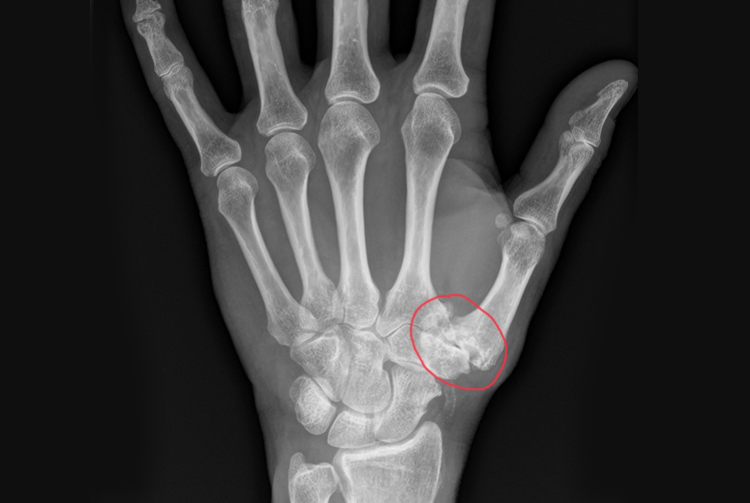
X-ray of Eaton Grade 3 thumb CMC Arthritis with subluxation of the joint
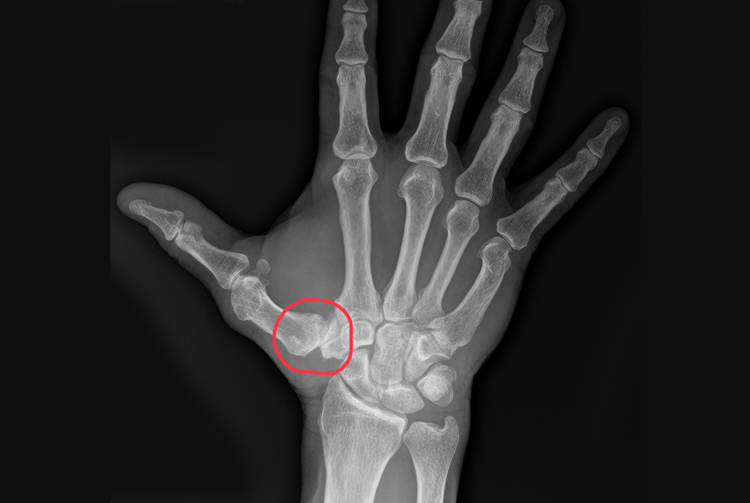
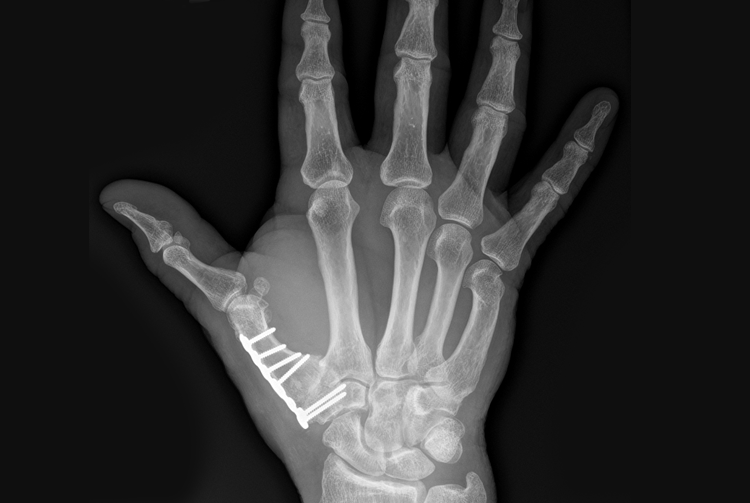
X-ray of thumb CMC fusion in the patient above
What causes thumb CMC arthritis?
Several factors may contribute, including:
- Some people inherit characteristics that affect the shape, stability, or mechanics of the thumb joint and may make arthritis more likely to develop.
- A previous injury. A fracture, ligament injury, sports injury, car accident, or other trauma can damage the joint or change how forces pass through it. Arthritis that develops as a result of an earlier injury is referred to as post-traumatic arthritis.
- Repetitive use. Occupations and activities involving frequent gripping, pinching, twisting, or forceful hand movements can repeatedly load the base of the thumb. This may include certain types of manual labor, as well as occupations such as hairstyling and other jobs that require extensive hand use.
- Cartilage and other joint tissues change over time, making arthritis more common as people get older.
What are the symptoms of thumb CMC arthritis?
The most common symptom is pain at the base of the thumb, close to the wrist. The pain usually occurs with activities such as pinching a key, turning a doorknob, and opening a jar. The base of the thumb is often swollen, deformed, and tender.
Initially, discomfort may occur only during activities that place additional force through the joint. Patients commonly notice pain while opening a tightly sealed container, turning a key, twisting a lid, or pinching an object between the thumb and index finger.
As arthritis progresses, the pain may become more frequent or occur with less demanding activities. Some patients experience an ongoing ache after prolonged hand use.
The joint may also feel tender to the touch. Swelling and stiffness can develop, and some patients notice decreased grip or pinch strength. This weakness can make it harder to hold or manipulate objects securely. With more advanced arthritis, function decreases.
How is thumb CMC arthritis diagnosed?
Diagnosing thumb CMC arthritis begins with a discussion with Dr. Kavi Sachar. He will inquire about your symptoms, where the pain occurs, how long it has been present, which activities aggravate it, and whether there has been a previous injury.
During the physical examination, Dr. Sachar evaluates the thumb for tenderness, swelling, range of motion, strength, stability, and changes in alignment. Dr. Sachar is often able to reproduce the pain, and X-rays will help confirm the diagnosis. X-rays also allow Dr. Sachar to examine the space between the bones and look for other signs of arthritis.
What are the stages of thumb CMC arthritis?
Thumb CMC arthritis can be classified according to its appearance on X-rays. One commonly used system is the Eaton classification, which divides the condition into four stages.
- Eaton Stage 1 represents the earliest stage. There may be subtle changes within the joint, even though the X-ray can appear relatively normal.
- Eaton Stage 2 represents mild arthritis. Early narrowing within the joint and small bone spurs may be visible.
- Eaton Stage 3 represents more advanced arthritis. There is significant loss of space between the bones, and larger bone spurs may be present.
- Eaton Stage 4 includes advanced CMC arthritis along with arthritis in a nearby area called the STT joint, a small joint near the base of the thumb and wrist.
Importantly, the stage seen on an X-ray does not always predict how much pain a patient will experience. A person can have substantial arthritic changes and relatively modest symptoms, while another person may have considerable pain with less advanced changes. Diagnosis therefore considers the patient’s symptoms, physical examination, hand function, and X-rays together.
About Dr. Kavi Sachar
Kavi Sachar, MD, is a renowned orthopedic surgeon at The Steadman Clinic who specializes in hand, wrist, and elbow disorders and surgery. His focus is on restoring function through innovative open and arthroscopic techniques. His approach begins with understanding how a condition is affecting the individual patient.
For people experiencing pain at the base of the thumb, an evaluation can help determine whether CMC arthritis is responsible for the symptoms and how advanced the condition has become. Contact Dr. Sachar at The Steadman Clinic in Vail, Frisco, or Basalt, Colorado, to schedule your consultation today. Dr. Sachar regularly sees patients from Denver and throughout the U.S.
At a Glance
Dr. Kavi Sachar
- Specializing in Hand, Wrist, & Elbow Surgery
- Board Certified Orthopedic & Hand Surgeon
- Consultant to the US Ski & Snowboard Team & Colorado Avalanche
- Learn more
